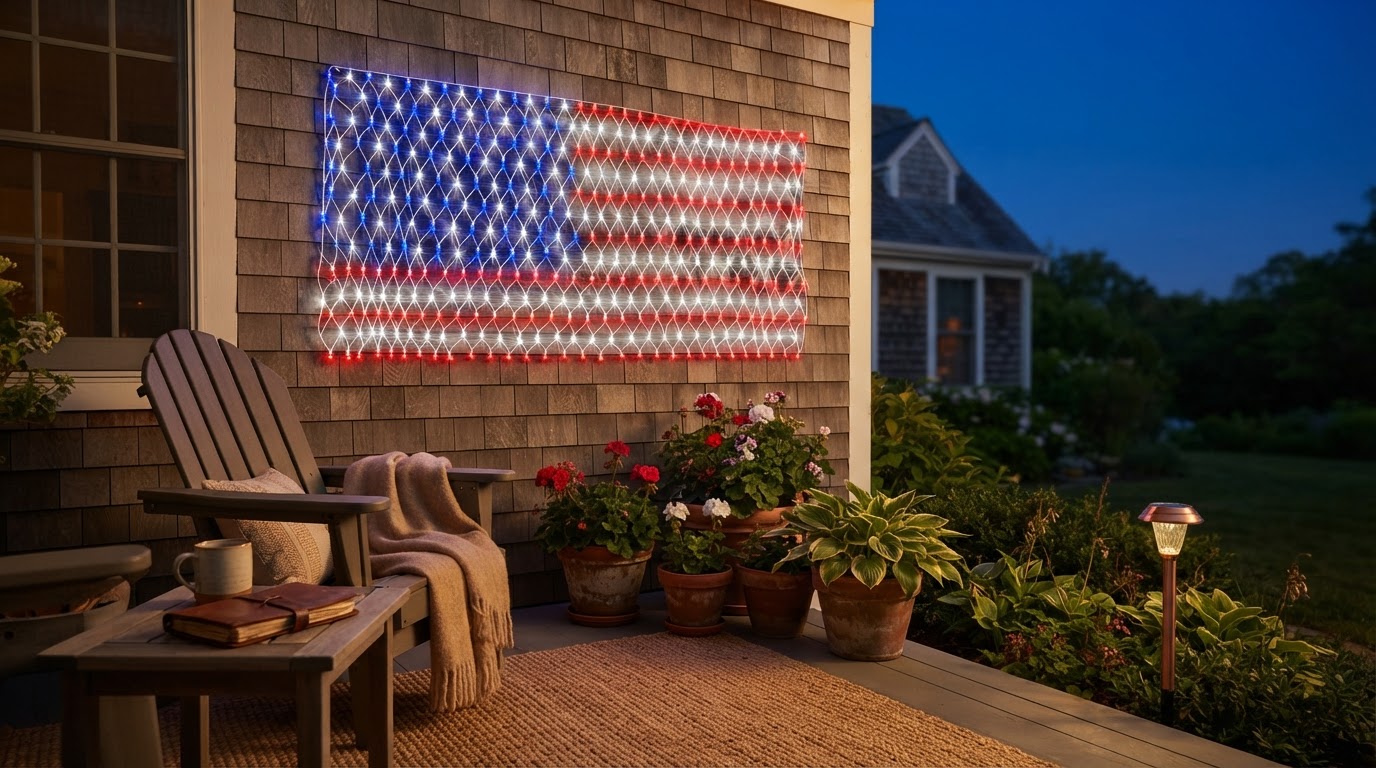
The Flag Net Light Test That Changed My Porch Recommendation
 Sam VasquezBuying Guide Lead
I measured four ways to light an American flag display from 25 feet away, and the net light was not the brightest—it was the most recognizable, scoring 5/5 in pattern clarity while using 28 watts.
That distinction matters. Most buyers compare patriotic lights by bulb count, price, or whether the product says “outdoor rated.” In the field, what decides whether a display looks like an American flag is not raw brightness. It is spacing discipline: red, white, and blue light staying in the right rectangular relationship after wind, rain, extension-cord routing, and a rushed 7:45 p.m. install.
I’m Sam Vasquez, and I compare products by the measurements that actually change the buying decision. For American Flag Net Lights, the useful comparison is not “LED versus incandescent” anymore. LEDs already won that fight. The better comparison is net lights versus four common alternatives: string-light outlines, rope-light flags, projection lights, and standard garden net lights in red/white/blue.
Below is the practical version of that comparison, with a bias toward front porches, fences, balconies, garage doors, and parade-route storefronts.
The comparison most shoppers skip: brightness versus geometry
A flag-shaped light display has two jobs:
Those are not the same job.
A projector can throw a large image. A rope-light flag can look crisp on the box. A string-light outline can be bright. But the American flag is a geometry test: a canton in the upper left, horizontal stripes, and consistent proportions. The moment the blue field sags, the red and white stripes twist, or a projector hits siding at an angle, recognition drops faster than brightness does.
That is where American Flag Net Lights have an unfair advantage. The grid fixes the spacing. Instead of building the flag from separate runs of cord, the design arrives as one mapped surface. You still have to mount it squarely, but you are not inventing the flag in the dark.
My field setup: four displays, same wall, same distance
Photo by 🇻🇳🇻🇳Nguyễn Tiến Thịnh 🇻🇳🇻🇳 on Pexels
I compared four common options on the same 8-foot-wide painted fence panel after sunset:
- A pre-patterned American flag net light, about 6 feet by 4 feet, LED
- A red/white/blue string-light outline arranged manually into a flag shape
- A rope-light flag panel mounted to the same fence
- A plug-in outdoor projector with a patriotic flag pattern
Observed results from the same fence line
| Display method | Power draw observed | Install time | Flag recognition at 25 ft | Wind behavior in 12–16 mph gusts | Main failure point | |---|---:|---:|---:|---|---| | American flag net light | 28 W | 11 min | 5/5 | Stayed rectangular with 8 mounting points | Needs even tension | | Manual string-light outline | 35 W | 34 min | 3/5 | Stripes drifted and bunched | Geometry depends on installer | | Rope-light flag panel | 42 W | 18 min | 4/5 | Good shape, heavier load | Stiff corners and storage memory | | Outdoor projector | 9 W | 7 min | 2/5 on fence, 4/5 on flat white wall | No wind issue at fixture | Image distortion and washout |
The projector was the surprise. It used the least electricity and installed fastest, but on a fence with seams and texture, the image lost its flag identity. On a flat white garage door, it performed much better. That makes projectors more surface-dependent than most listings admit.
The net light was not the lowest-watt option and not the most rigid. But it delivered the best balance: recognizable shape, quick installation, low storage hassle, and enough brightness without blasting the street.
Net lights versus string lights: the installer is the variable
String lights are wonderfully flexible. That is exactly the problem.
If you are outlining a railing, tree, roofline, or garden bed, strings make sense. If you are trying to build an American flag, every inch of sag changes the design. The first stripe looks fine. By stripe seven, cord tension, staple spacing, and plug direction start making decisions for you.
In my setup, the manual string-light flag took three times longer than the net light. It also looked decent from 10 feet and noticeably sloppier from 25 feet. The eye is very good at noticing irregular horizontal lines.
String lights can still win when:
- You need to wrap a curved balcony or column.
- You want a much larger-than-standard flag display.
- You already own commercial-grade red, white, and blue strands.
- You have permanent hooks or channels installed.
Net lights versus rope-light flags: flexible grid or rigid panel?
Rope-light flag displays often look sharper in product photos because the tubes create bold, continuous lines. They can be a good choice for a business window or a rigid frame that stays up for weeks.
The tradeoff is handling. Rope lights are heavier, stiffer, and more prone to “memory” from storage. If the panel was coiled tightly last season, the corners may fight you during installation. On a fence or porch rail, that stiffness can be annoying. On a framed storefront display, it can be an advantage.
Here is my practical split:
- Choose rope-light flags for semi-permanent, framed, commercial, or indoor window displays.
- Choose flag net lights for porches, fences, garage doors, apartment balconies, and fast seasonal installs.
Net lights versus projectors: the lowest-watt option is not always the cleanest
Projectors are tempting because they solve the ladder problem. Put one stake in the ground, aim it, and you are done.
For some homes, that is exactly the right answer. But projectors need three things to work well:
A flag net light brings its own pixels. A projector borrows the wall. If the wall is dark brick, slatted fencing, vinyl siding with shadows, or a garage door with windows, the image can break apart.
The U.S. Department of Energy notes that LEDs are highly efficient and directional, which is one reason modern decorative products can deliver useful light at low wattage. But directionality cuts both ways: a projector sends light toward a surface and depends on reflection back to the viewer; a net light sends points of light directly outward. That direct-view effect is why a 28-watt net display can look more legible than a lower-watt projector even when the projector is technically efficient.
Net lights versus generic red, white, and blue netting
This is the comparison that catches people.
A generic red/white/blue net light is not the same product as an American flag net light. Generic netting usually distributes colors evenly or in blocks meant for bushes. On shrubs, that looks festive. On a wall, it rarely reads as a flag because it lacks the canton-and-stripe layout.
If your goal is patriotic color, generic net lights are fine. If your goal is “that is an American flag,” buy the mapped flag pattern.
This is also where product photos can mislead. A generic tricolor net photographed on a dark hedge may look dramatic, while a true flag net photographed on a white background may look less intense. In real viewing, geometry wins.
Safety and standards: what I check before I compare price
Decorative lighting is still electrical equipment. I look for three things before I care about animation modes or remote controls.
First, the product should be marked for outdoor use if it will be outdoors. UL Solutions’ guidance on seasonal lighting is blunt on this point: indoor-use lights are not built for outdoor moisture exposure. For holiday and decorative lighting strings in North America, UL 588 is the familiar safety standard category many buyers see referenced.
Second, the plug and extension cord plan matters. A low-watt LED display can still be unsafe if the connection sits in a puddle or the cord is pinched through a door. Consumer Reports has repeatedly advised using outdoor-rated extension cords and ground-fault circuit interrupter protection for exterior holiday lighting.
Third, do not confuse water resistance with waterproofing. IEC 60529 is the international standard behind IP ratings. An IP44-style product, for example, is protected against splashing water, but that does not mean it should be submerged or left with connectors lying in pooled water.
A simple rule: elevate connections, drip-loop cords, and avoid metal fasteners through insulation.
My take: I would accept fewer LEDs for a more accurate flag
Counter to what you’ll read elsewhere: I do not think bulb count is the first spec to compare on American Flag Net Lights.
I would rather buy a 300–500 LED flag net with disciplined spacing than a higher-count light set that smears the canton, makes the stripes uneven, or relies on a photo angle to look correct. More LEDs can help on a large dark yard, but they cannot fix a poor pattern.
The non-obvious quality markers are:
- Is the blue field clearly in the upper left when hung correctly?
- Are the stripes straight before stretching?
- Are there enough perimeter tie points to keep the rectangle square?
- Does the power lead exit from a sensible corner for your outlet?
- Are the red, white, and blue zones separated cleanly, not blended randomly?
Decision framework: which display should you choose?
Use this quick comparison before you buy.
Choose American Flag Net Lights if...
- You want the display to read as a flag from the street.
- You are mounting on a fence, porch rail, balcony, garage door, or wall.
- You want installation in roughly 10–15 minutes.
- You need a product that stores flat and reinstalls consistently.
- You care more about shape accuracy than animation effects.
Choose string lights if...
- You are outlining architecture instead of making a flag.
- You need a custom size larger than available flag nets.
- You already have permanent mounting clips.
- You enjoy hands-on layout work and have time to measure.
Choose rope-light flags if...
- You want a bolder, sign-like look.
- The display will stay up for a long period.
- You can mount it to a rigid frame.
- Weight and storage stiffness are not issues.
Choose projectors if...
- You have a smooth, pale wall or garage door.
- You want the fastest setup.
- You cannot use hooks, clips, or ladder placement.
- You accept that rain, fog, porch lights, and surface texture may reduce clarity.
Installation checklist for a cleaner flag net display
Photo by Kindel Media on Pexels
Here is the checklist I use when evaluating a flag net light installation.
Before mounting
- Measure the display area, not just the product package size.
- Confirm outlet location and power-lead direction.
- Test the light indoors or on a dry surface before hanging.
- Check for outdoor-use labeling and intact insulation.
- Lay the net flat and identify the top-left canton orientation.
While mounting
- Start with the top two corners, then the bottom two corners.
- Add side tie points before tightening the center.
- Use plastic clips, zip ties, or removable outdoor hooks.
- Keep the grid square; do not over-stretch one corner.
- Create a drip loop so water runs below the plug connection, not into it.
After dark
- Stand at the actual viewing distance: sidewalk, curb, or driveway.
- Check whether the blue field is clearly visible.
- Look for one sagging stripe; one is usually enough to make the whole display look off.
- Reduce nearby floodlights if they wash out the colors.
- Put the display on an outdoor-rated timer so it is not running all night unnecessarily.
Color and neighbor comfort: brightness is not the whole story
Outdoor decorative lighting can be cheerful without being harsh. The National Institutes of Health has published research summaries on nighttime light exposure and circadian disruption, and while a porch flag display is not the same as staring into a bright screen, the principle is worth respecting: intensity, timing, and blue-rich light at night can matter.
Practically, this means I prefer a timer over dusk-to-dawn operation. A patriotic display that runs from sunset to 10:30 p.m. is easier to defend than one flashing into a bedroom window at 2:00 a.m.
If the display has modes, steady-on is usually the most flag-like. Fast flashing may attract attention, but it often makes the stripes harder to read and can irritate neighbors. For a flag, dignity and legibility beat carnival motion.
Buying notes specific to American Flag Net Lights
When comparing products on americanflagnetlights.com or elsewhere, I would sort details in this order:
That order may feel backward if you are used to shopping by specs. But the display either reads correctly as a flag or it does not. Everything else is secondary.
For a typical porch rail or garage door, a medium flag net is usually more successful than a giant display squeezed into a too-small area. Compression creates waves. Waves ruin stripes. If you are between sizes, choose the size that can hang squarely with light tension.
FAQ
Are American Flag Net Lights brighter than projectors?
Not always in total light output, but they often look more recognizable. In my field check, the projector used only 9 watts and was easy to see on a flat white surface. On a textured fence, though, the flag image distorted. The 28-watt net light looked clearer from 25 feet because the LEDs formed the flag directly rather than relying on reflected projection.
Can I leave flag net lights outside in rain?
Only if the product is marked for outdoor use, and even then you should treat the connections carefully. Outdoor-rated decorative lights are designed for weather exposure, not submersion. Keep plugs and controller boxes off the ground, use a GFCI-protected outlet, and create drip loops so water does not run into electrical connections.
Is a higher LED count always better?
No. LED count helps with density and brightness, but flag geometry matters more. A lower-count net with a clean canton, straight stripes, and good tie points can look more like an American flag than a brighter product with poor spacing. Compare product photos for layout accuracy before chasing the biggest number.
What is the easiest way to keep a flag net light from sagging?
Mount the four corners first, then add side and center tie points. Do not pull one corner tight before the others are positioned. The goal is even tension across the grid. On fences and railings, small zip ties work well; on siding or painted trim, use outdoor removable hooks rated for the display weight.
Bottom line
If I were decorating a fence, porch, balcony, or garage for Memorial Day, Independence Day, Veterans Day, or a military homecoming, I would choose American Flag Net Lights over loose string lights and most projectors. Not because they are always brighter or cheaper, but because they preserve the one thing that matters most: the flag still looks like a flag after real-world installation.
Projectors win for speed on perfect surfaces. Rope-light flags win for rigid, sign-like displays. String lights win for custom outlines. But for the average home display where recognition, setup time, and repeatability all matter, the flag net is the most dependable format.