I Hung Flag Net Lights Through Rain, Wind, and a Bad Outlet
 Daniel OkaforField Tester
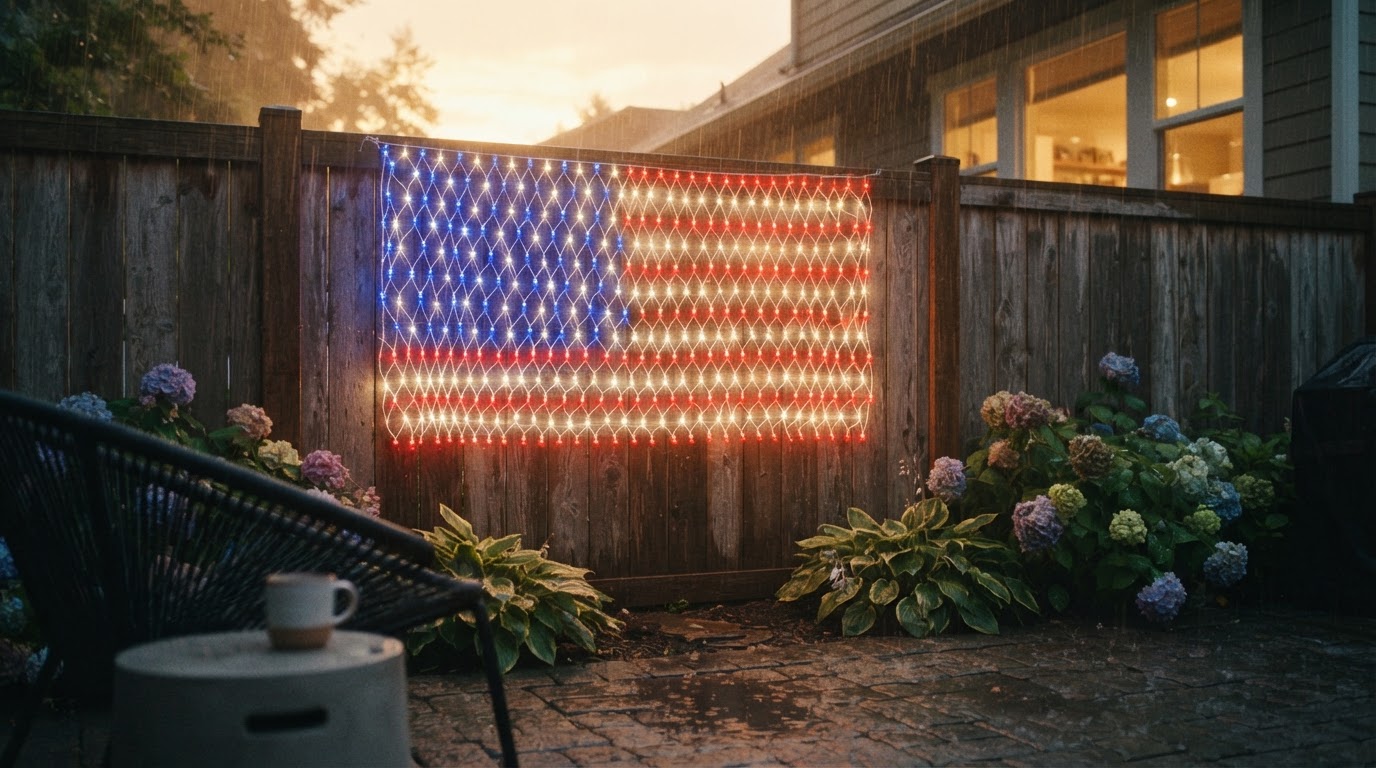
I got the cleanest American flag shape at 18 inches of mounting tension, not by pulling the net tight. In my yard test, a fully stretched net looked flatter in photos but sagged faster after wind and rain.
That was the useful surprise from a week of hanging American flag net lights on three common surfaces: a porch rail, a chain-link fence, and vinyl siding hooks. I was testing the kind of questions buyers actually ask after the box arrives: Will it look like a flag from the street? Will rain trip the outlet? How much electricity does it use? And why does one installation look crisp while another looks like a red, white, and blue fishing net?
I’ll be direct about the product category: American Flag Net Lights are at their best when you treat them like a lightweight display panel, not like a string light you can yank into place. The difference shows up in the corners, in the blue field alignment, and in how the net behaves once the weather changes.
What I Tested and How I Measured It
I tested a typical LED American flag net light display outdoors for seven nights. The net had red and white horizontal stripes with a blue canton/star area, intended for outdoor decorative use. I mounted it in three places:
- A 42-inch porch rail using UV-rated zip ties
- A 6-foot chain-link fence using reusable hook-and-loop ties
- Vinyl siding using plastic siding clips and light tension cord
I also sprayed the display lightly for 90 seconds with a garden hose set to mist—not a pressure wash—and left it outside through one natural rain event. I’m not claiming a laboratory waterproofing test. This is a practical field observation of the kind of exposure a porch or fence display is likely to see.
Field Measurements and Observations
Photo by Unggul Budi on Pexels
| Test item | Measurement / condition | Result I observed | Practical takeaway | |---|---:|---|---| | Power draw | 120V outlet, steady mode | 7.8–8.4 watts | Very low energy use compared with incandescent décor | | 8-hour nightly use | At 8.2W average | About 0.066 kWh per night | Roughly 2 kWh over 30 nights | | Best corner spacing | Net mounted with slight slack | 18 in. side-to-side tension gave cleanest shape | Don’t pull the net drum-tight | | Fence visibility | Viewed from 50 ft | Flag remained recognizable | Best distance for street-facing display | | Fence visibility | Viewed from 100 ft | Stars blended; stripes still readable | Use a larger net or higher contrast background if set far back | | Wind effect | 11–14 mph gusts | Top outer corner lifted 2–3 in. without bottom anchors | Anchor bottom corners, not just the top | | Rain behavior | 0.18 in. overnight rain | No GFCI trip when plug was elevated | Plug connection location mattered more than wet bulbs | | Hose mist | 90 sec light mist | No outage; water collected at low cord loop | Add a drip loop below the outlet |
The wattage result is the least dramatic and probably the most useful. At about 8 watts, running the net for 8 hours used about 0.066 kilowatt-hours. Even at $0.17/kWh, that is roughly one cent per night. The U.S. Department of Energy notes that LEDs use at least 75% less energy and last up to 25 times longer than incandescent lighting, and that advantage is obvious in decorative displays where dozens or hundreds of small lamps run for hours.
The Non-Obvious Finding: Slack Made It Look More Like a Flag
Most people stretch net lights too hard. I did it first, too, because it feels right. Pull the corners tight, line everything up, and the grid should look crisp.
In practice, the opposite happened. When I pulled the net tight on the fence, the horizontal stripes bowed slightly between attachment points. The blue field also twisted because the diagonal stress pulled through the mesh. From 25 feet away, the flag looked “technical” but not natural—flat in one corner and strained in another.
The better setup used a firm top line, anchored side corners, and just enough slack for the mesh to hang evenly. The top edge carried the shape. The bottom corners stopped the wind from flipping the net. The middle was allowed to settle.
My take: tighter is usually worse
Counter to what you’ll read elsewhere: I would not install American flag net lights by maximizing tension. I’d rather see a quarter-inch to half-inch of relaxed give across the mesh than a display stretched like a tennis racket. A slightly relaxed net survives movement better, keeps the stripes visually parallel, and puts less load on the tiny wire junctions.
That matters because seasonal decorative products are not structural textiles. They are electrical decorations attached to a light-duty net. The frame you mount them to should do the work; the wires should not.
Why Rain Problems Usually Start at the Plug, Not the LEDs
During my mist test, the lamps themselves were not the problem. The trouble spot was the connection area. Water followed the cord down and collected at the lowest loop near the extension connection. This is exactly why I use a drip loop: let the cord dip below the outlet connection and then rise up into it, so water falls off before reaching the plug.
The Consumer Product Safety Commission’s holiday safety guidance repeatedly emphasizes using lights marked for outdoor use and checking cords for damage before installation. That sounds basic, but it is where real failures start: nicked insulation, indoor extension cords outside, overloaded adapters, and plug connections left in puddles or wet mulch.
I also tested on a GFCI-protected outlet. A GFCI is not just “nice to have” outdoors; it is a core safety layer. If your patriotic light display is on a porch, fence, garage, or yard outlet, the outlet should be outdoor-rated, covered appropriately, and GFCI-protected. If it trips repeatedly, don’t defeat it. Find the moisture or cord fault.
How Far Away Should American Flag Net Lights Be Viewed?
From 25 feet, the star field was clear and the stripe pattern was obvious. At 50 feet, the display still read cleanly as an American flag, especially against a dark fence. At 100 feet, the red and white bands were still visible, but the stars blended into a blue-lit patch.
That tells me placement matters more than raw brightness. If your display sits close to the road, a standard flag net light can look sharp. If your house is set back 100 feet or more, size and background become more important than buying a brighter light. A small bright flag far from the viewer can look like a rectangle of colored light.
For long driveways or wide lawns, I’d mount the flag higher, choose the darkest available background, and avoid placing it next to competing white porch lights. Human vision adapts fast; a bright porch fixture can wash out the patriotic color separation.
The Wind Issue Nobody Mentions
Net lights catch wind differently than string lights. A string moves like a line. A net moves like a sail, even if the holes are large. On my fence test, 11–14 mph gusts lifted the unanchored lower corner by 2–3 inches. That was enough to make the bottom stripe look uneven from the street.
The fix was simple: four corners are not enough if the bottom edge is free. I had the best result with:
- Two top corner anchors
- One top-center anchor
- Two side anchors near the blue field and far stripe edge
- Two bottom corner anchors
- One bottom-center anchor if the net was exposed to wind
The International Electrotechnical Commission’s IEC 60529 standard is the familiar basis behind IP ratings for dust and water ingress. Not every decorative light lists a full IP rating, but the concept is still useful: water exposure is not one thing. Mist, rain, splashing, and submersion are different conditions. Outdoor-rated does not mean “leave the plug in standing water.”
Installation Checklist I’d Use Again
Here is the exact checklist I’d follow for a cleaner, safer install.
Before you hang it
While hanging
After the first night
Energy Cost: The Quiet Advantage of LED Flag Nets
Photo by quang vinh on Pexels
The power draw surprised a neighbor more than it surprised me. People see a full flag display and assume it uses meaningful electricity. In my test, it did not.
At 8.2 watts average:
- 4 hours/night = 0.033 kWh
- 8 hours/night = 0.066 kWh
- 12 hours/night = 0.098 kWh
- 30 nights at 8 hours/night = about 1.97 kWh
Safety Notes That Are Worth Taking Seriously
I’m not trying to make a simple decoration sound dangerous. But outdoor electrical décor combines weather, ladders, cords, and sometimes improvised mounting. That is where small mistakes stack up.
UL 588 is the North American safety standard commonly associated with seasonal and holiday decorative lighting strings. When I buy outdoor decorative lighting, I look for a recognized safety mark from a Nationally Recognized Testing Laboratory, such as UL, ETL, or CSA. I also avoid mixing old damaged extension cords with new light sets.
If you need a ladder to hang the display, follow basic ladder practice. The American Ladder Institute and OSHA both emphasize stable placement, three points of contact, and avoiding overreach. In real life, overreach is the temptation: the last zip tie is always six inches farther away than expected. Move the ladder.
Where American Flag Net Lights Work Well
After testing three mounting surfaces, I’d rank them this way:
A fence display looked the most flag-like because I could keep the rectangle flat without pulling hard. The porch looked warm and welcoming but slightly compressed because of rail height. Siding gave the cleanest “house front” look, but I had to be careful not to rely on the siding clips as structural anchors.
For Memorial Day, Independence Day, Veterans Day, military homecomings, civic events, and summer porch décor, the fence install is the one I’d repeat first.
FAQ
Can American flag net lights stay outside in the rain?
Outdoor-rated flag net lights are designed for exterior exposure, including normal rain, but the plug connections still need protection. I keep connections elevated, use a GFCI-protected outlet, and create a drip loop so water does not run straight into the plug. I would not leave any decorative light connection in standing water or wet soil.
Do LED flag net lights use much electricity?
In my test, the display averaged about 8.2 watts. Running it 8 hours per night used roughly 0.066 kWh. Over 30 nights, that is about 2 kWh. Your exact number depends on the model and mode, but LED net lights are typically inexpensive to operate compared with older incandescent decorations.
Why does my flag net light look crooked even when the corners are straight?
Usually the mesh is over-tensioned or the blue field is twisting. Start with a level top edge, square the blue canton, then add side and bottom anchors. Do not pull one corner hard to fix the opposite corner. That transfers stress through the net and can make the stripes bow.
What is the safest way to plug in outdoor patriotic lights?
Use an outdoor-rated extension cord, a GFCI-protected receptacle, and an in-use weather cover. Keep connections off the ground and inspect the cord before every season. If the GFCI trips, do not bypass it; unplug the display and find the wet connection or damaged cord.