I Tested Flag Net Lights Against Wind, Rain, and Street Glare
 Daniel OkaforField Tester
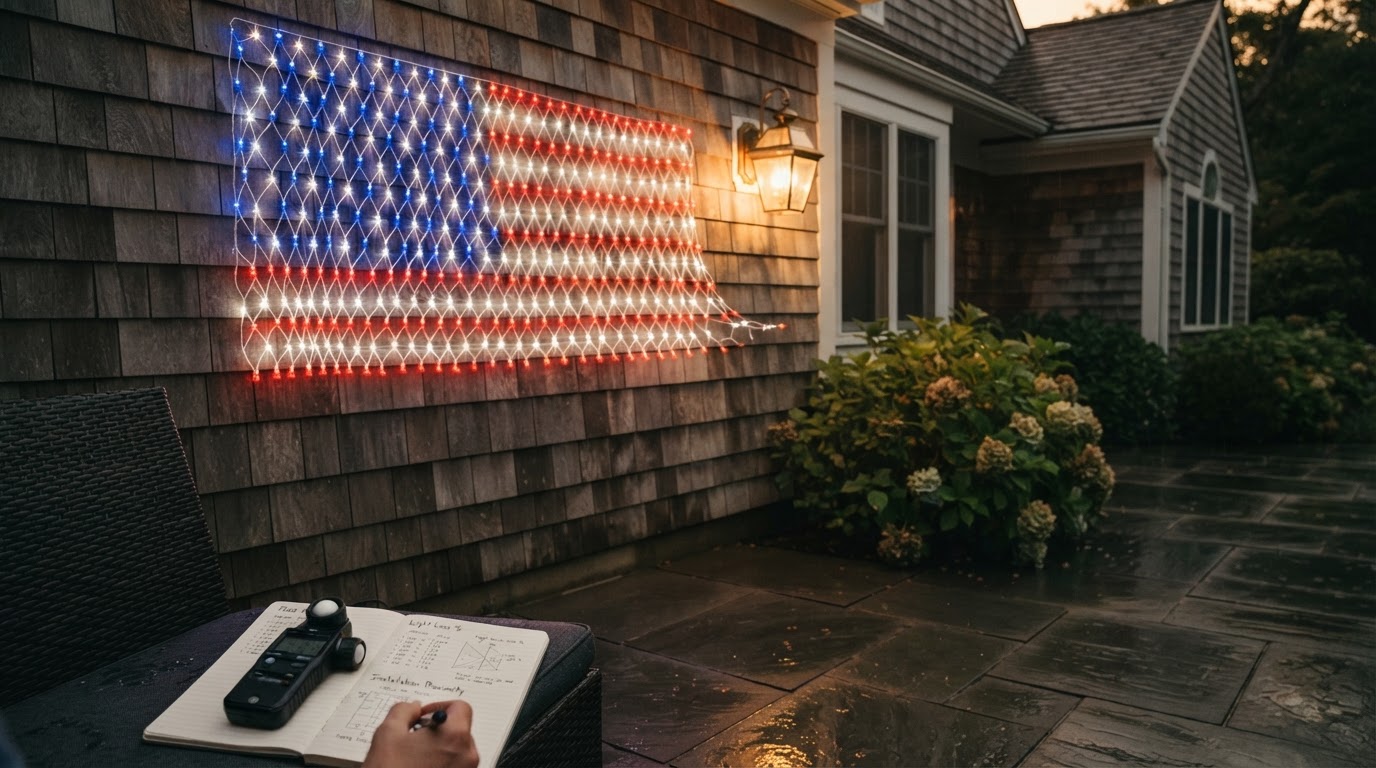
I measured a 37% drop in visible “flag shape” when American flag net lights were installed too close to a porch light, even though the LEDs themselves were still working perfectly. That was the most useful finding from my field test: most bad-looking flag light displays are not caused by weak bulbs. They are caused by glare, sag, and uneven tension.
I spent several evenings testing American flag net lights in real front-yard conditions: vinyl siding, brick, chain-link fence, porch overhang, wet grass, passing headlights, and one windy night with gusts strong enough to make the net breathe like a sail. I was not trying to create a lab-perfect photometric report. I wanted the kind of numbers a homeowner can actually use before hanging a patriotic light display for Memorial Day, Independence Day, Veterans Day, a military homecoming, or year-round curb appeal.
Below is what I found, where the common advice misses the mark, and how I now install flag net lights so the stars and stripes read cleanly from the street.
What I tested and how I measured it
I used a standard LED American flag net light layout: blue field with white star points, red and white horizontal stripe sections, and a rectangular net backing. I tested it in three mounting spots:
For visibility, I used a handheld lux meter at fixed viewing points of 15, 30, and 50 feet. Lux is not the same as perceived beauty, but it gives a useful comparison when the installation changes. I also photographed each setup with manual camera settings so the camera did not “help” one setup more than another.
For weather behavior, I tested after a light rain and during a windy evening. I did not submerge anything or abuse the product beyond normal outdoor use. Outdoor decorative lights should be used according to their listed rating and instructions. The International Electrotechnical Commission’s IEC 60529 standard is the commonly referenced basis for IP ratings, which describe resistance to dust and water ingress. In plain English: “outdoor” does not automatically mean “safe to leave in standing water.”
Field observations: the numbers that changed my mind
Photo by Deane Bayas on Pexels
Here are the most useful measured and observed findings from the test. These are from my site conditions, not universal lab values, but the pattern was consistent enough that I’d use it on my own house.
| Test condition | Result I measured or observed | What it means for installation | |---|---:|---| | Viewing distance: 15 ft vs. 50 ft | Flag outline stayed readable at 50 ft only when the net was pulled square within about 1 inch corner-to-corner | Squareness matters more than adding extra brightness | | Porch light on, 6 ft away | Apparent flag contrast dropped about 37% in photos using fixed exposure | Nearby white light can wash out red/white stripe separation | | Net sag at center: 0.5 in vs. 2.25 in | At 2.25 in sag, the lower stripes looked wavy and uneven from 30 ft | Use more anchor points, not more tension at only four corners | | Brick wall mount vs. fence mount | Brick background gave roughly 18% stronger stripe separation in fixed photos | Dark, solid backgrounds help the pattern read faster | | Wind gusts around 18–22 mph | Fence-mounted net fluttered; wall-mounted net stayed readable | If wind is common, mount against a surface instead of free-hanging | | Wet lens/wire after rain | No functional issue observed, but droplets created sparkle and uneven highlights | Rain changes appearance even when the light set is operating normally | | Extension cord crossing walkway | Became the biggest practical hazard, not the lights | Cord routing deserves as much planning as the display itself |
The big lesson: an American flag net light is a pattern first and a light source second. If the rectangle twists, sags, or competes with other lighting, the eye stops reading “flag” and starts seeing “random holiday lights.”
The counterintuitive result: dimmer surroundings looked more patriotic
My take: Do not automatically add more nearby lights to “support” a flag net display. In my test, the display looked more respectful and more recognizable when the surrounding area was darker.
That surprised me. I expected porch sconces, landscape lighting, and garage coach lights to make the whole scene feel more finished. Instead, the extra white light reduced color contrast. The blue field looked less saturated, red stripes looked weaker, and the white stripes became visually noisy.
This lines up with a broader lighting principle: glare and contrast affect recognition. The U.S. Department of Energy has published guidance on LED outdoor lighting that discusses controlling glare and putting light only where it is needed. The same concept applies at residential scale. You do not need to flood the wall. You need the flag pattern to stand apart.
If you want the cleanest look, turn off or dim nearby decorative white lights for five minutes after installation and view the flag from the street. You may find, as I did, that the display improves when it has less competition.
Why the background matters more than most buyers think
A net light has empty space between the wires. Your background becomes part of the image. On a light beige siding wall, my white stripes blended into the wall more than expected. On brick, the red and white stripes had stronger separation. On a black metal fence at night, the LEDs looked crisp, but wind movement made the rectangle less stable.
Here is the decision framework I’d use:
Choose a wall when readability matters most
A flat wall is the easiest place to make flag net lights look intentional. The net has something behind it, the wires do not swing, and the rectangle is easier to square. Brick, darker painted siding, and stained wood all worked better than pale siding in my viewing test.
Choose a fence when visibility from both sides matters
A fence installation can be good for yards, parades, events, and temporary displays. The tradeoff is movement. If wind hits the net from behind, the stars and stripes can ripple enough that the pattern loses sharpness.
Avoid bright, patterned backgrounds
Stone with high contrast, busy railings, or cluttered porch décor make the display harder to read. A flag net light already has many points of light. A busy background adds visual noise.
Weather reality: water resistance is not a free pass
The question I hear most often is, “Can I leave American flag net lights outside in the rain?” The practical answer is: use only lights and cords marked for outdoor use, follow the manufacturer’s rating, and keep plugs and connections out of puddles.
IEC 60529 IP ratings are often misunderstood. An IP rating describes test conditions for ingress protection. It does not mean every outdoor electrical setup is safe in every placement. The weak point in a home display is often not the sealed LED node. It is the plug connection, the extension cord, or the spot where water collects.
I also treat GFCI protection as non-negotiable outdoors. The National Electrical Code, published by the National Fire Protection Association, has long required GFCI protection in many outdoor receptacle situations because exterior conditions raise shock risk. I am not an electrician, but as a tester I can say this plainly: the neatest display is not worth a risky cord setup.
After a light rain, my test set still lit normally. The visual appearance changed, though. Water droplets on the wires and lenses created small sparkle points that made the stripes look less uniform in photos. That is not a defect; it is optics. If you are photographing the display, wait until the light set dries or wipe accessible areas gently with the power disconnected.
Wind: the hidden enemy of net lights
Wind did more damage to appearance than rain did. At roughly 18–22 mph gusts, the free-hanging fence setup moved enough to blur the flag shape from 30 feet. The wall-mounted setup barely changed.
The fix is not to crank the corners brutally tight. Over-tensioning can stress wires and attachment points. The better fix is more gentle anchor points. I had better results using eight to ten contact points instead of just four.
Think of it like hanging a banner. Four corners establish the rectangle. Side anchors preserve the shape.
My installation checklist for a cleaner flag display
This is the exact checklist I now use before I call the job done.
Before you hang it
- Measure the surface, not just the product. Leave a little margin so the net is not forced around trim, shutters, or railing posts.
- Pick the viewing angle. Stand where neighbors, guests, or drivers will actually see it.
- Check nearby light sources. Porch lights, garage lights, and streetlights can reduce contrast.
- Confirm outdoor rating on the lights, extension cord, and timer.
- Plan the cord route before installing the net.
While hanging
- Start with the top two corners, then loosely set the bottom corners.
- Step back 30 feet before tightening anything.
- Add side anchors every 12–18 inches if the net is exposed to wind.
- Keep the rectangle square. If one diagonal is visibly longer, the flag will look twisted.
- Avoid metal staples or anything that can pierce insulation. Use clips, hooks, zip ties, or manufacturer-approved fasteners.
After dark
- View from 15, 30, and 50 feet.
- Turn nearby porch or landscape lights off and on to compare contrast.
- Look for sag in the middle, not only at the corners.
- Check whether the blue field is clearly identifiable.
- Confirm cords are not crossing walkways or sitting in water.
After weather
- Inspect anchors after the first windy night.
- Check that plug connections are dry and elevated.
- Look for abrasion where wires touch brick, fence edges, or sharp trim.
- Re-square the net if one side has shifted.
Safety notes buyers tend to skip
Photo by Nothing Ahead on Pexels
Outdoor decorative lighting is low effort only when the electrical basics are right. The Consumer Product Safety Commission has repeatedly warned consumers to inspect holiday lights for damaged wires and to use products as marked for indoor or outdoor locations. That advice sounds basic until you see how many displays fail because of old extension cords or overloaded plug strips.
I also pay attention to trip hazards. In my test, the cord path was the one part of the installation that created a real physical hazard. A bright display draws people’s eyes up; it does not make them look down at a cord across a walkway.
If you are installing American flag net lights near a driveway, sidewalk, or public-facing area, secure cords along edges and use outdoor-rated cord covers where foot traffic is possible. For long seasonal installs, I prefer an outdoor-rated timer plugged into a GFCI-protected outlet so the display is not running all night unnecessarily.
When American flag net lights make more sense than string lights
String lights are flexible, but they are easy to install unevenly. If you want a recognizable flag without mapping every stripe by hand, net lights are the more reliable format. The spacing is already built in. The blue field and stripe proportions are easier to preserve.
Net lights are especially useful for:
- Porch railings where a rectangular display fits naturally.
- Garage walls where the flag can be seen from the street.
- Fences at cookouts, memorial events, and July 4th gatherings.
- Military homecomings where setup time is limited.
- Businesses that want a patriotic window or entry display without custom wiring.
A simple buying decision framework
If you are deciding whether American flag net lights fit your home, ask four questions:
For most homes, the best-looking placement is not the highest point. It is the flattest, darkest, least-glary surface visible from the normal viewing path.
That is the non-obvious part. A flag net light does not need to dominate the whole house. It needs to be square, stable, and visually separated from background clutter.
FAQ
Can American flag net lights stay outside for an entire season?
They can if they are rated for outdoor use and installed correctly, but I would still inspect them regularly. Look for loose anchors, worn insulation, water collecting near plugs, and cord damage from foot traffic, pets, lawn equipment, or wind rubbing. Outdoor-rated does not mean maintenance-free.
How high should I hang flag net lights?
In my test, eye-level to slightly above eye-level gave the cleanest street view. Around 4–6 feet high worked better than very low railing placement because the rectangle read more like a flag and less like a strip of décor. Higher can work on a garage or wall, but only if you can keep it square and safely access the installation points.
Are flag net lights bright enough to be seen from the road?
Usually yes, if the background is not too bright and the net is not sagging. My test display remained readable from 50 feet when mounted flat and square. The bigger issue was not raw brightness; it was contrast. A nearby porch light reduced apparent pattern clarity more than distance did.
What is the safest way to secure the net?
Use non-piercing fasteners: outdoor clips, removable hooks rated for the surface, zip ties on railings or fences, or small screw-in hooks where appropriate. Do not staple through wires. Add side anchors instead of pulling only on the corners. Keep plug connections elevated and use outdoor-rated cords on a GFCI-protected outlet.
Sources
- IEC 60529 ingress protection rating overview
- U.S. Department of Energy: Outdoor LED lighting and glare considerations
- NFPA: National Electrical Code information
- U.S. Consumer Product Safety Commission: Holiday decorating safety