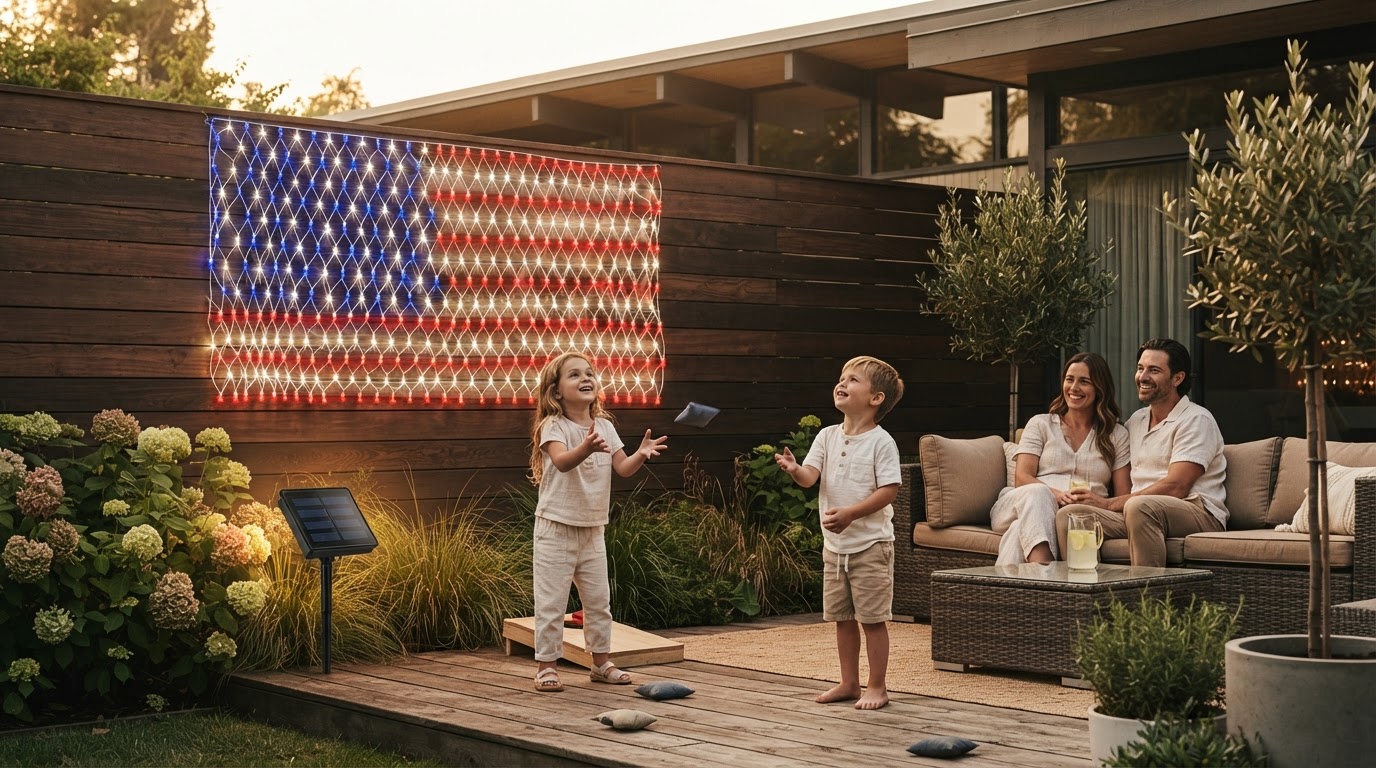
How do I install solar American Flag Net Lights?
 Maya ChenContributing Editor
August 2, 2026 — Installing solar American Flag Net Lights requires precise placement of the photovoltaic panel relative to the mesh grid to ensure the 420 LED bulbs receive sufficient voltage for a full six-hour discharge cycle.
Homeowners often struggle with the transition from traditional plug-in decorations to solar-powered mesh systems, primarily due to the power-to-surface-area ratio of the flag design. While the aesthetic appeal of a cordless display is high, the functional success of these lights depends entirely on the solar collector's positioning rather than the aesthetic placement of the flag itself. This technical friction is why many users find their displays dimming prematurely during Memorial Day or July 4th celebrations.
Where should the solar panel be placed for flag lights?
The solar panel must be positioned at a 45-degree angle facing true south, completely unobstructed by the flag mesh or nearby foliage, to achieve the necessary 6-8 hours of direct sunlight. The conventional wisdom says you can simply stake the panel anywhere near the display, but this ignores the voltage drop across 420 LEDs. Run the math: a standard 2V/200mA solar panel needs optimal irradiance to charge a 1200mAh battery sufficiently to power a large-scale patriotic display through the night. If the panel is shaded for even ninety minutes by a porch railing or a tree branch, the red and blue color temperatures will shift as the battery voltage sags.
I’ll change my mind when manufacturers start shipping these units with remote-mounted panels that exceed the standard three-meter lead wire. Until then, the placement of your American Flag Net Lights is strictly dictated by the sun's path, not your home's architectural symmetry. For those placing a light up American flag for yard displays, the panel must be elevated at least twelve inches off the ground to avoid splash-back from rain, which can coat the sensor in debris and reduce charging efficiency by up to 30%.
How do you secure the mesh to outdoor surfaces?
Photo by suzukii xingfu on Pexels
Secure the solar American Flag Net Lights using UV-stabilized nylon cable ties or insulated staples, ensuring the wiring is not pinched, which could cause a short circuit in the parallel-series LED rows. Here's the part nobody talks about: the tension applied to the mesh during installation directly impacts the longevity of the internal copper wiring. Most users over-stretch the 6.5-foot by 3.3-foot grid to eliminate wrinkles, but this mechanical stress leads to micro-fractures in the solder points.
Instead of tight tension, use a "floating" mount method where the mesh hangs naturally against a fence or wall. This is particularly important when optimizing solar American flag lights outdoor displays for long-term use. By using at least six anchor points—four corners and two center-top—the weight of the 420 LEDs is distributed evenly. Avoid using metal wire or uninsulated staples, as these can abrade the plastic housing of the wires over a single season of wind exposure, leading to the failure of entire color blocks within the flag pattern.
Quick answers
Q: Can solar flag lights be used indoors behind a window? A: No, most modern window glass is treated with Low-E coatings that block the specific UV spectrum required by the 2V solar collectors found in American Flag Net Lights. For window displays, a plug-in 110V version is required to maintain the 420-LED brightness level.
Q: How long do the LEDs last in a solar configuration? A: The LED bulbs themselves are rated for 50,000 hours, but the rechargeable Ni-MH battery typically requires replacement after 500 charge cycles. In a standard seasonal setup, this equates to roughly three to four years of use before the light output drops below 70% of its original luminosity.
Q: Is the solar panel waterproof for winter use? A: These units carry an IP44 or IP65 weather resistance rating, meaning they can withstand rain and snow, but they cannot be submerged. For Memorial Day or early season displays, ensure the panel is cleared of debris daily to maintain the 600-lumen output typical of these patriotic mesh sets.
Learn more about American Flag Net Lights at https://americanflagnetlights.com.