Solar Showdown: Debunking American Flag Net Lights Efficiency
 Maya ChenContributing Editor
June 18, 2026 — As the mid-summer holiday season approaches, the market for renewable holiday displays is seeing a surge in solar-integrated patriotic decor. While industry proponents claim significant ecological benefits, the actual utility of these devices depends heavily on specific hardware configurations and regional irradiance levels.
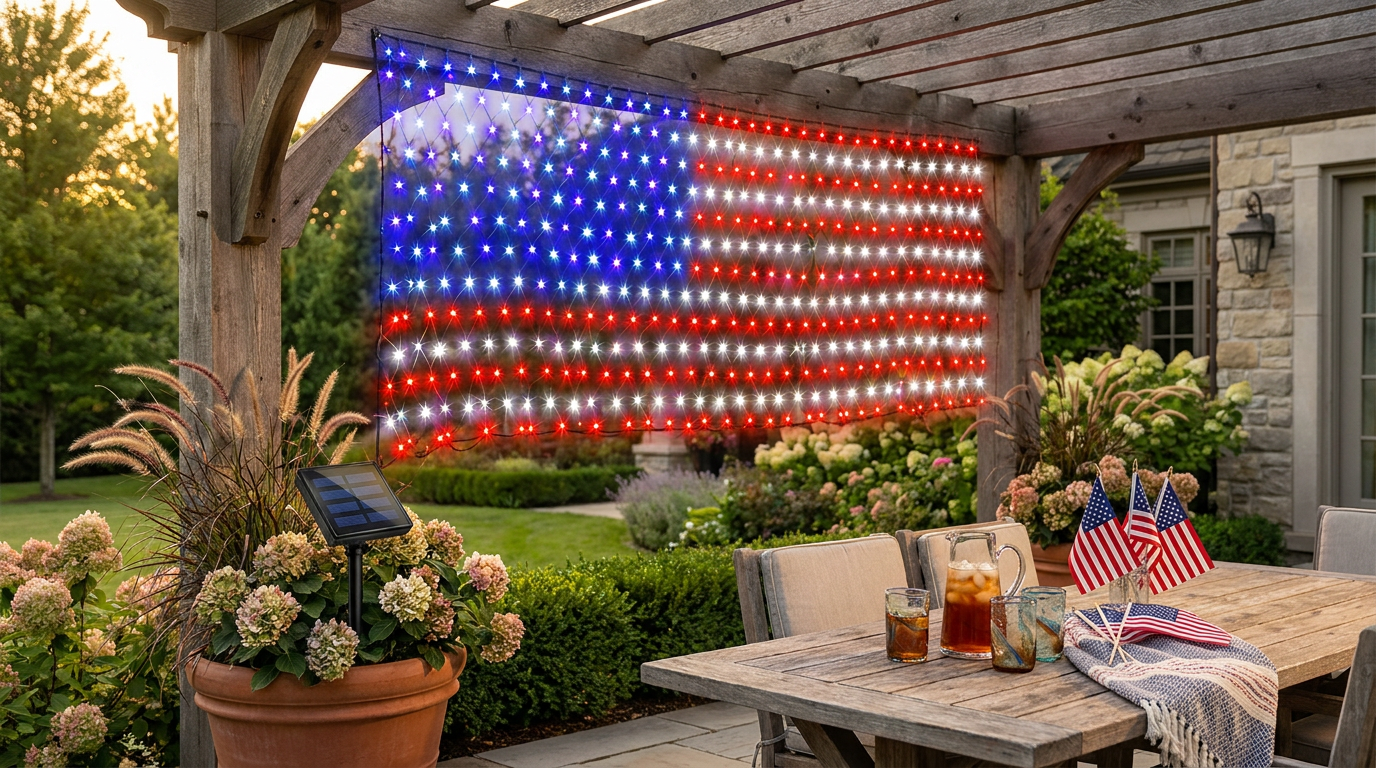
The conventional wisdom says that switching to solar-powered patriotic displays is a guaranteed financial win for the average homeowner. Here's the part nobody talks about: the ROI on a 420 LED array is negligible when compared to modern low-voltage grid-tied systems, yet the convenience factor of the dual-power [American Flag Net Lights](/blog/what-makes-american-flag-net-lights-unique) remains its primary market driver. According to Flagpole Farm, solar flagpole lights are marketed as tools to reduce electricity bills and offer long-term savings, but these savings often take years to offset the initial hardware premium.
Photo by Angelo Capitanio on Pexels
Run the math: The American Flag Net Lights unit features a 6.5ft x 3.28ft mesh containing 420 LEDs. While Solvao notes that solar products help collectors adhere to the U.S. Flag Code by providing consistent nighttime illumination without manual intervention, the actual energy offset for a seasonal 8-mode display is minimal. The IP65 waterproof rating and the inclusion of a USB backup power supply suggest that manufacturers are aware of the limitations of solar-only setups in overcast climates.
Expert tip: To maximize the lifespan of the 420 LED net, users should utilize the remote control's timing settings to limit operation to the four hours immediately following dusk. This prevents deep discharge cycles on the internal battery, which is the most common failure point in IP65-rated solar consumer goods.
Despite the skepticism regarding total energy independence, the integration of light sensors for auto on/off functionality does solve a logistical hurdle for large-scale displays. For those managing multiple installations, the ability to bypass traditional wiring remains a tactical advantage.
I'll change my mind when independent laboratory testing shows that these small-scale photovoltaic cells can maintain a 100% charge through a standard 8-hour cycle in Northern latitudes during the winter solstice. Until then, the dual-power USB option remains a necessary crutch for reliability.